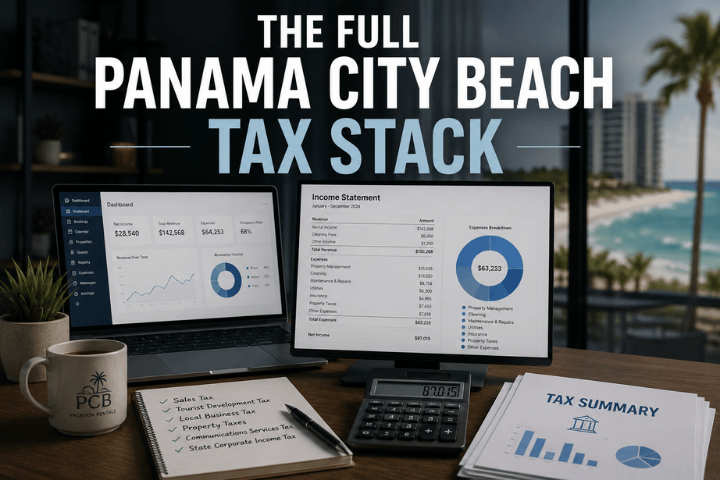
Taxes on a Panama City Beach rental aren't one line — they're a stack, paid to different agencies on different schedules, and partly automated by the booking platforms and partly not. Getting the stack right is the difference between a clean operation and a quiet, compounding back-tax problem. This post lays out every layer, who collects it, and where it goes.
The Two Transient Taxes
For a typical PCB short-term stay (six months or less), two taxes apply to the rental:
- Florida state sales tax on transient rentals — 6%. Administered by the Florida Department of Revenue (DOR).
- Bay County Tourist Development Tax (the "bed tax") — 5%. Administered directly by Bay County (the Clerk of Court), not by the state.
That's a combined ~11% on the taxable rental amount in Panama City Beach. (Some sources also reference a discretionary sales surtax component administered with the state portion; confirm the current combined state rate for your parcel with the DOR.)
The Taxable Base is Bigger than the Nightly Rate
Both taxes generally apply to the total a guest must pay to occupy the unit, not just the nightly rate. That includes cleaning fees, pet fees, resort fees, and, for properties inside PCB city limits, the city license fee passed through to the guest. If you've been taxing only the room rate, you've been under-collecting.
The Collection "Gap" — What the Platforms Do and Don't Do
This is the operational crux:
- State sales tax: Airbnb and Vrbo generally collect and remit the state portion for your bookings.
- Bay County's 5% TDT: because Bay County self-administers its bed tax, the platforms generally do not collect or remit it. You are responsible for collecting the 5% from guests and remitting it directly to Bay County.
Owners who assume "the platform handles my taxes" are usually right about the state and wrong about the county — and the county's share accrues as a liability with penalties and interest. Direct bookings (your own website, repeat guests) add another wrinkle: there, you typically owe the full stack, since no platform is remitting anything.
The Local Business Layer
Operating inside PCB city limits also requires a Business Tax Receipt (BTR) — the local business license that's part of your certificate paperwork and whose number appears on your required signage. Fee structures for the BTR are set by the city and can change, so confirm the current amount and renewal cycle with the City of Panama City Beach rather than assuming.
| Layer | Rate/Type | Collected By | Remitted To |
| State Sales Tax (transient) | 6% + Applicable Surtax | Platforms (usually) | Florida Dept. of Revenue |
| Bay County TDT (bed tax) | 5% | You (platforms usually don't) | Bay County Clerk of Court |
| Local Business Tax | Set by city | You | City of Panama City Beach (BTR) |
| Taxable Base | Room Rate + Required Fees | -- | -- |
A Clean Compliance Routine
- Register first. Set up a DOR sales-tax account and a Bay County tourist-tax account before your first paid booking; obtain your PCB BTR.
- Charge the full combined rate on the full taxable base for every booking, including fees.
- Reconcile platform collections monthly. Credit what the platform remitted to the state; collect and remit the county's 5% yourself.
- File on each agency's schedule. The county's filing calendar is independent of the state's; a lapse on one doesn't excuse the other.
- Keep per-stay records of rates and fees so your taxable base is defensible in an audit.
Buying an Existing Rental? Audit the Tax History
Unremitted bed tax can follow the operation. During due diligence, ask the seller for proof of TDT registration and recent filings, and confirm the BTR and DOR accounts are current. It's a fair, standard question — and a cheaper one to ask before closing than after.
The Final Word
In Panama City Beach you collect roughly 11% in transient taxes on the full price a guest pays, but the responsibility is split: the platforms generally cover the state 6%, while the county's 5% bed tax is yours to collect and remit directly. Register before your first booking, tax the full base, reconcile monthly, and file to each agency on its own schedule.