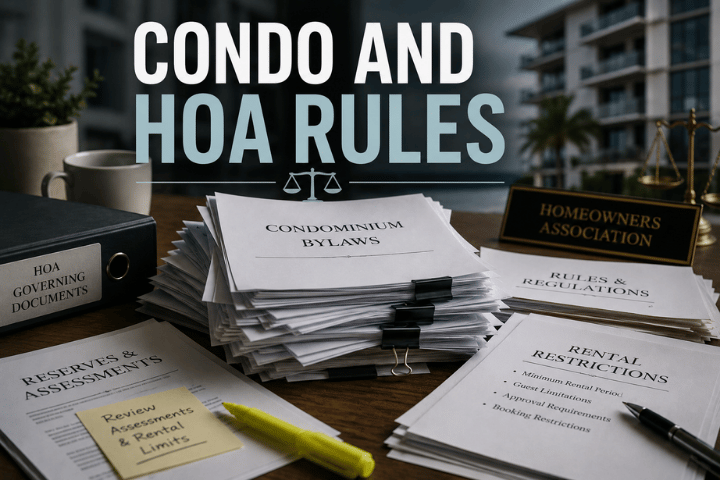
You can do everything right at the state, county, and city level — DBPR license, Vacation Rental Certificate, tourist-tax registration, passed inspection — and still be unable to legally rent your property short-term. The reason is the layer most owners check last and should check first: the condominium declaration or homeowners-association rules. In a high-rise beach market like Panama City Beach, where a large share of rentable inventory is condos, this private layer is often the binding constraint.
This post explains why association documents can override your plans and how to vet them before you buy. It's general education, not legal advice.
Private Rules can be More Strict Than the Law
Florida's preemption stops governments from banning short-term rentals; it does not stop a condo association or HOA from restricting or prohibiting them. These are private, contractual rules you agree to by owning in the community, and they can be considerably tighter than anything the city imposes. An association may:
- Ban short-term rentals entirely, or allow them only above a minimum length (e.g., 7-day, 30-day, or longer minimums)
- Cap the number of rentals per year or limit how soon a new owner can begin renting (a "waiting period" after purchase)
- Limit the number of units that can be rented at once (rental caps / waitlists)
- Require association registration, approval, or a guest/tenant screening process
- Restrict keys, fobs, parking passes, pool/amenity access for short-term guests
- Impose their own occupancy, pet, noise, and signage rules
Because these live in the declaration, bylaws, and rules — not in any public ordinance — they're invisible unless you go read them.
The #1 Due-Diligence Item for Condo Buyers
If your investment thesis depends on short-term rental income, the association documents either support that thesis or destroy it. A beautiful Gulf-front unit in a building with a 30-day minimum is not a nightly-rental investment, no matter how clean your city paperwork is. So before you close:
- Get the full governing documents — declaration, bylaws, articles, and current rules/regulations — not just the marketing summary.
- Read the rental provisions specifically, including minimum stay, caps, waiting periods, and approval/registration steps.
- Request an estoppel certificate and current financials to confirm dues, assessments, and any rental-related fees.
- Confirm amenity access for guests — a unit whose renters can't use the pool or get parking passes is a weaker product.
- Ask whether rules changes are pending. Associations can amend rental rules by vote; a community trending toward restriction is a risk even if today's rules are permissive.
The Assessment Risk every Florida Condo Buyer should Price In
Separate from rental rules, Florida condo ownership now carries a cost dimension that directly affects returns. Following the 2021 Surfside collapse, Florida enacted laws (commonly referenced as the 2022 condo safety reforms) requiring milestone structural inspections and structural integrity reserve studies, with limits on waiving reserves for older and taller buildings. The result across many Florida condo communities has been higher reserve contributions and special assessments.
For an STR investor, that means a coastal condo's true carrying cost may be rising independent of your rental performance. Underwrite for it: ask for the reserve study, the milestone-inspection status, and any approved or anticipated special assessments before you buy.
For Homeowners Already in a Community
If you own and are thinking about renting, start with your own documents and your board. Quietly listing a unit in violation of the declaration invites fines, legal action from the association, and friction with neighbors — and associations can be more aggressive enforcers than city code officers. If the rules allow rentals with registration or approval, follow that process to the letter.
The Bottom Line
Government approval is necessary but not sufficient. In condo-heavy Panama City Beach, the declaration and HOA rules are frequently the deciding factor in whether a property can be rented short-term at all — and Florida's post-Surfside reserve requirements add a real cost variable on top. Read the documents first, price the assessments in, and never assume city compliance means you're clear.