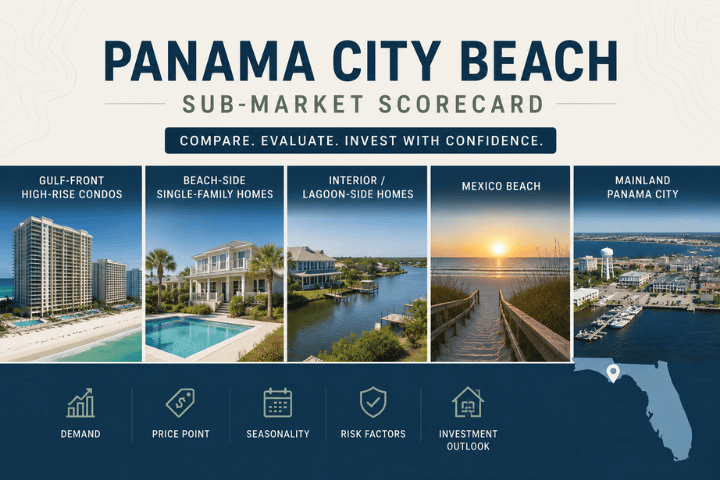
"Panama City Beach" isn't one investment — it's several, and they behave differently. A Gulf-front high-rise condo, a beach-side single-family home, an interior or lagoon-side house, the quieter Mexico Beach market, and the mainland Panama City market each carry their own mix of entry price, demand, regulatory friction, and carrying cost. This scorecard gives you a framework for comparing them. It is not investment advice and not a set of return guarantees — it's a structured way to ask better questions about a specific property.
A note up front: we're a property management company, not financial advisors. The grades below are an educational framework reflecting general market characteristics, not a recommendation to buy or a projection of your returns. Underwrite every property individually with your own numbers.
What the Scorecard Weighs
For each submarket, consider six factors:
- Demand Depth — how reliably it fills, and how weather-/season-dependent that demand is
- Rate Ceiling (ADR) — how high nightly rates can realistically go in peak
- Entry Price — acquisition cost relative to income potential
- Regulatory Friction — certificate/inspection burden plus condo/HOA constraints
- Carrying-cost drag — insurance, HOA dues/assessments, coastal maintenance
- Resilience/Appreciation — storm exposure, code vintage, and longer-term value trajectory
The right property for you depends on which of these you weight most heavily — cash flow today vs. appreciation, simplicity vs. yield, peak ADR vs. steady occupancy.
Submarket-by-Submarket Framework
Gulf-front high-rise condos (PCB) The headline product: strong demand, high peak ADRs, and turnkey amenity stacks. The catch is carrying cost and control — HOA dues, post-Surfside reserve/assessment exposure, expensive coastal insurance, and association rules that can cap or limit rentals. High gross, but the net and the rules require scrutiny. Strengths: demand, ADR, amenities. Watch: assessments, insurance, HOA rental limits.
Beach-Side Single-Family Homes (PCB) More control than a condo, strong family demand (PCB's deliberate market), and room for amenity differentiation (private pool, space). Higher entry price and full exposure to coastal insurance and maintenance, but no HOA rental caps to navigate in many cases. Strengths: control, family demand, amenity upside. Watch: entry price, insurance, maintenance.
Interior / Lagoon-Side Homes (PCB) Lower entry price and lower carrying cost, with demand that leans on value-seeking families and proximity (not beachfront). Often the better cash-on-cash play even without headline ADRs, provided you price and position realistically. Strengths: entry price, carrying cost, yield potential. Watch: lower ADR ceiling, demand depth.
Mexico Beach A smaller, loyal, family/fishing market with a newer, resilience-forward housing stock post-Michael. Lower peak ADRs than PCB but strong repeat and shoulder-season demand, and a resilience/insurability edge. Underwrite occupancy conservatively given the smaller market. Strengths: resilience, repeat demand, character. Watch: smaller market, lower ADR ceiling.
Mainland Panama City Not a beach market — blended, year-round demand from jobs, healthcare, military adjacency, and downtown/St. Andrews character. Lower entry prices and steadier occupancy can support solid returns; verify the city's own STR rules. Strengths: entry price, steady/longer stays, weather independence. Watch: lower vacation ADR, city-specific rules.
How Do I Use This Information?
- Decide what you're optimizing for first. Peak ADR, steady cash flow, low management complexity, and appreciation pull toward different submarkets.
- Net, don't gross. A high-revenue Gulf-front condo with steep assessments and insurance can net less than a modest interior home. Build the full cost stack — including coastal maintenance and insurance and the tax stack — into every comparison.
- Confirm the rules before you fall in love. Regulatory and HOA status can disqualify a property regardless of its numbers.
- Get Area-Specific Quotes. Insurance, dues, and assessments are property-specific and frequently decisive.
What Really Matters
Treat PCB as a portfolio of submarkets, not one market. Match the submarket to your goal, underwrite the net with real coastal insurance and assessment numbers, and confirm the regulatory and HOA status before you commit. The scorecard is a lens for asking the right questions — your own diligence supplies the answers.