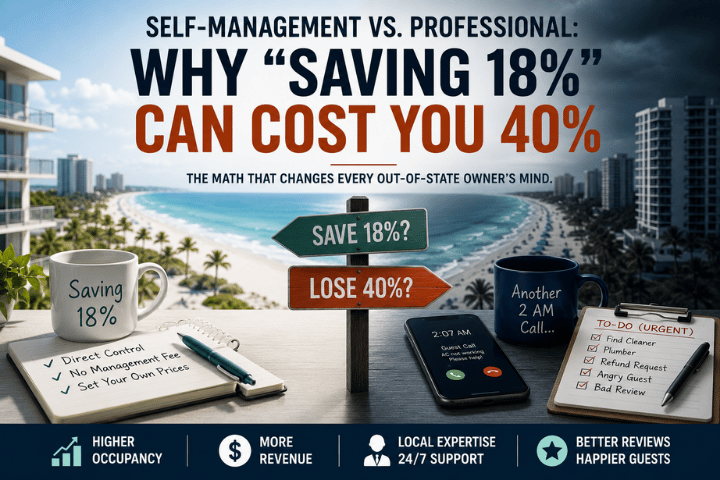
You bought a condo in Panama City Beach. You run a tight ship in Atlanta — or Nashville, or Charlotte. You're organized, tech-savvy, and frankly a little skeptical that a property manager is worth 18–20% of your gross revenue. So you set up a smart lock, listed on Airbnb, and figured you'd handle it yourself.
We're not here to talk you out of being independent. We're here to show you what the numbers actually say — because the owners who have run both approaches usually come to the same conclusion, and it costs real money to learn it the hard way.
THE GOOD: Direct Control — and No Management Fee on Every Dollar
Let's be fair: self-management has real advantages. You set your own rates, approve your own guests, and you keep that 18–20% commission instead of writing a check to someone else. For owners who live locally and treat their rental like a part-time job, this can genuinely work.
You also know your own property better than anyone. If you want to keep a specific calendar blocked, allow pets on certain weeks, or hold it for family, you can — no negotiating with a manager who has 40 other units to think about.
These are real benefits. The problem is they tend to look biggest on a spreadsheet before you've experienced a PCB summer weekend.
THE BAD: Welcome to your New Second Job: Being the 2AM Plumber
Panama City Beach doesn't operate on a 9-to-5 schedule, and neither do your guests' problems. A backed-up toilet doesn't wait until morning. Neither does a broken A/C in July, a lockout at midnight, or a guest who arrives to find the previous cleaner left towels on the floor and a sink full of dishes.
From Nashville, your options are: call around frantically for a last-minute handyman at a premium rate, ask the guests to be patient (and watch your review rating drop), or fly down yourself. Professional management firms maintain vetted vendor networks precisely because this happens constantly. Their operations teams have backup cleaners, on-call maintenance, and local contacts who answer the phone — because their business model depends on it, not just your one unit.
The hidden cost here isn't just money. It's the Saturday afternoon calls, the stress of being responsible for strangers' vacations from 600 miles away, and the gradual erosion of your review score when response times suffer.
THE UGLY: The Occupancy Gap Nobody Warns You About
Here's where the math breaks open. The fee you're trying to avoid is 18–20%. The gap you're likely accepting is far larger.
| Professionally Managed Properties | Self-Managed Properties |
| 75% - Average Annual Occupancy | 40% - Average Annual Occupancy |
That's not a small difference. On a condo generating $80,000 at full potential, closing a 35-point occupancy gap represents roughly $28,000 in additional booking revenue — before you've touched a single management fee. Paying 18% on $80,000 costs you $14,400. Trying to keep that $14,400 by going it alone, while running at 40% occupancy instead of 75%, costs you nearly twice as much.
The occupancy gap exists because professional managers have algorithmic pricing tools that update daily, established OTA relationships that improve search ranking, and marketing pipelines that fill shoulder-season gaps that self-managed properties routinely leave empty. Your well-crafted Airbnb listing simply doesn't compete on the same terms — and in PCB, where the high season is short and every off-peak week counts, that difference compounds fast.