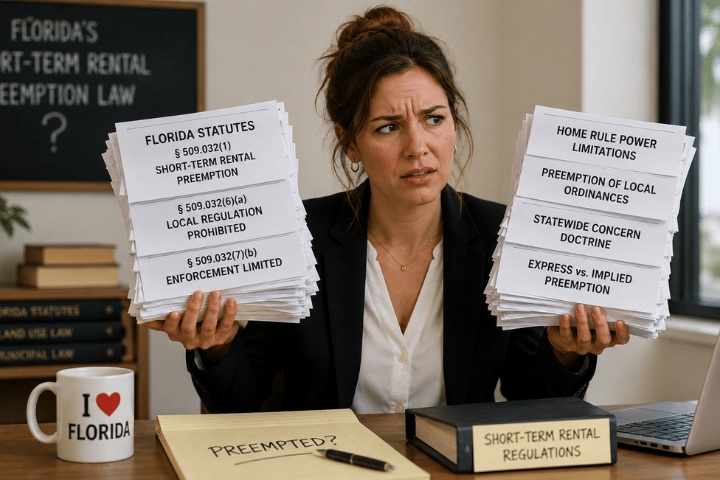
Before you read a single local ordinance, you need to understand the rule that sits above all of them: Florida's short-term rental preemption. It's the reason a city like Panama City Beach can require certificates, inspections, and signage but cannot simply ban vacation rentals — and it's the reason the rules differ so sharply from one Florida town to the next. This post explains the preemption in plain terms and what it does and doesn't allow.
This is a statewide framework piece referenced throughout our Gulf Coast guides. It is general education, not legal advice.
The Core Rule
The controlling language lives in Florida Statutes § 509.032(7). In plain terms, it does two big things:
- Cities and counties cannot prohibit short-term rentals outright. A local government can't zone vacation rentals out of existence or ban them in residential areas as a blanket matter.
- Cities and counties cannot regulate the duration or frequency of stays. They can't say "no rentals shorter than 30 days" or "no more than X rentals per year" as a general rule.
The first piece dates to 2011; the duration/frequency limit was clarified in 2014. Together they create a floor of predictability that has made Florida one of the more investor-friendly states for vacation rentals: your basic right to operate is protected at the state level.
The Grandfather Clause — The Most Important Exception
Here's the exception that trips people up. Any local ordinance that was already in place before June 1, 2011, is grandfathered and remains fully enforceable — including outright bans and minimum-stay rules that would otherwise be preempted.
The textbook example is Miami Beach, which restricted short-term rentals in most residential zones before 2011 and can still enforce those restrictions today. Sanibel and a handful of others sit in the same category. The practical lesson: preemption protects you only in jurisdictions that didn't already restrict STRs before mid-2011. Always check whether your specific city or county has pre-2011 rules on the books.
Good news for our region: the Gulf Coast markets we cover regulate through operational rules (registration, inspections, safety, taxes), not pre-2011 bans — so the preemption's protections generally apply, and the local rules are about how you operate, not whether you can.
What Local Governments Absolutely Can Still Do
Preemption is a floor, not a ceiling on all regulation. Cities and counties retain broad authority to require:
- Registration or certificates and reasonable fees
- Life-safety and building inspections
- Occupancy limits (e.g., by square footage or bedroom-plus formulas)
- Parking, trash, noise, and signage standards
- A 24/7 responsible party reachable to resolve issues
- Display of license/registration numbers in listings
- Code-enforcement penalties for violations
This is exactly the toolkit Panama City Beach and Bay County use. None of it is a "ban," so none of it is preempted — which is why your compliance work is real even though your right to operate is protected.
Why This Matters For Your Underwriting
- A property's value depends partly on its regulatory status. A jurisdiction with pre-2011 restrictions is a fundamentally different investment from one operating under the standard preemption floor.
- "Florida is wide open" is a myth. The state blocks bans, but local registration, occupancy, and tax rules still bite — and ignoring them produces fines and de-listing, not freedom.
- Verify at the parcel level. Preemption status, grandfathering, and the applicable local program all depend on exactly where the property sits.
Our Final Thoughts
Florida law guarantees you can operate a short-term rental in most of the state and bars cities from dictating how long or how often you rent — unless they had restrictions in place before June 1, 2011, in which case those older rules stand. Everywhere else, expect robust operational regulation: certificates, inspections, occupancy, taxes. Know which world your property lives in before you buy.
This article is general educational information, not legal advice. Statutes and their interpretation change, and grandfathered local rules vary widely. Confirm your jurisdiction's status and consult a qualified Florida attorney for advice specific to your situation.